Supreme Court Temporarily Allows Trump White House Ballroom Construction to Continue
Chief Justice John Roberts granted an administrative stay Friday, pausing a lower-court order that would have halted construction on the $400 million White House ballroom project at midnight.
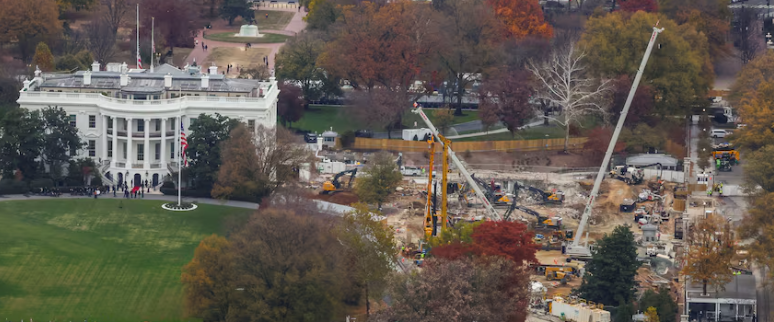
WASHINGTON — The U.S. Supreme Court on Friday issued an administrative stay that temporarily permits President Donald Trump's administration to keep building a massive new ballroom at the White House, pausing a lower-court order that would have forced most work to stop at midnight.
Chief Justice John Roberts, who handles emergency matters from the D.C. Circuit, granted the stay late Friday. The order does not decide whether the $400 million project is legal. It simply freezes the injunction while the justices review the administration's formal request to let construction proceed during ongoing litigation.
The Project
The ballroom, planned as a roughly 90,000-square-foot structure capable of seating up to 1,000 guests, sits on the site of the demolished East Wing. Officials describe it as part of an integrated complex that includes extensive underground national-security facilities — hardened concrete, missile and drone defenses, medical spaces, and other protective features. The administration has said the project is about 65 percent complete, with roughly 250 workers operating on 20-hour shifts seven days a week.
The Legal Fight
The legal fight began after the National Trust for Historic Preservation sued, arguing the White House cannot unilaterally demolish and rebuild major sections of the historic complex without congressional approval. Senior U.S. District Judge Richard Leon agreed in March, ruling that statutes and the Constitution's Property Clause give Congress exclusive authority over federal buildings in the District of Columbia.
A divided three-judge panel of the U.S. Court of Appeals for the D.C. Circuit upheld that decision on August 7, writing that each president is a "temporary tenant, not the owner," of the White House.
The appeals court stayed its own order for 14 days so the government could seek Supreme Court review. In its emergency filing, Solicitor General D. John Sauer argued that halting the work would jeopardize national security and the safety of the president, his family, and staff. The administration contends existing statutes authorizing alterations to the White House and national-security needs provide sufficient legal cover.
Critics, including the National Trust, counter that no statute expressly authorizes the construction and that private donations funding much of the project raise additional accountability concerns.
What Happens Next
Friday's administrative stay means construction can continue at least until the full Court acts on the stay application. The justices have not set a timetable for a further ruling.
Lower courts have repeatedly stressed that the dispute ultimately concerns the separation of powers: whether a president may reshape an iconic federal property without explicit legislative blessing. Trump welcomed the decision, calling the complex "vital for national security" and "the greatest of its kind."
Opponents vowed to keep pressing the case, warning that irreversible changes to the White House grounds could be locked in before the merits are fully resolved. The episode marks another high-stakes test of executive authority in the current administration.
While the temporary green light keeps bulldozers and steelworkers busy on the East Wing site, the larger constitutional question — who decides the future of the People's House — remains pending before the nation's highest court.
Related Articles
Trump Ushers in America's 250th with Fiery National Mall Speech
Jul 5, 2026

Manhattan High-Rise Evacuated After 'Buckling' Beams
Jul 7, 2026

Preliminary Hearing Begins in Tyler Robinson Case: Prosecutors Detail Evidence Against Alleged Assassin of Charlie Kirk
Jul 7, 2026

Paul Pelosi Involved in Hit-and-Run in California
Jul 5, 2026